%402x.svg)

What is multi-channel marketing? How SMBs win more leads
Organizations using three or more marketing channels see 287–494% higher purchase rates compared to single-channel campaigns. That number stops most business owners cold, and it should. Yet the majority of small and medium-sized businesses (SMBs) still rely on one or two channels, leaving enormous lead generation potential on the table. Multi-channel marketing is not a luxury reserved for enterprise brands with giant budgets. This guide breaks down exactly what it is, why the results are so dramatic, and how you can build a practical multi-channel strategy starting today, without overhauling your entire operation.
Table of Contents
- Defining multi-channel marketing
- Major benefits for SMBs: ROI, retention, and growth
- Common challenges and mistakes to avoid
- How SMBs can get started: Simple steps for success
- Perspective: Why multi-channel is the smart SMB starting point, but not the endgame
- Take your multi-channel marketing further with expert support
- Frequently asked questions
Key Takeaways
| Point | Details |
|---|---|
| Multi-channel advantages | Using multiple marketing channels drives higher purchase rates and stronger customer retention for SMBs. |
| Start simple, grow smart | Begin with two or three channels and coordinate your messaging to see fast, measurable results. |
| Avoid common pitfalls | Prevent data silos and inconsistent customer experiences by aligning your strategy and tracking from day one. |
| Plan for the future | Laying the groundwork now prepares your business to scale up to omnichannel approaches and deeper personalization later. |
Defining multi-channel marketing
Multi-channel marketing means reaching your customers and prospects through more than one platform or touchpoint, whether that is email, social media, your website, paid ads, print materials, or even in-person events. The goal is simple: show up where your audience already spends time, rather than hoping they find you in one specific place.
Here is where a lot of business owners get confused. Multi-channel marketing is not the same as omnichannel marketing. Omnichannel takes things further by fully integrating every channel so the customer experience is seamless and consistent across all of them. Multi-channel is less complex. Each channel can operate somewhat independently while still sharing a core message. Think of it as the foundation you build before you eventually connect everything together.
For SMBs, that distinction matters a lot. As SPX Commerce notes, multi-channel marketing offers flexibility and manageable complexity, making it a realistic starting point without requiring a massive technology investment upfront.
Some practical examples of multi-channel combinations that work well for SMBs:
- Email + social media: Nurture leads via email while building brand awareness on Instagram or LinkedIn
- Website + Google Ads: Capture organic traffic through SEO while using paid search to fill gaps
- Social media + print: Run local print ads that drive people to a landing page or social profile
- Content marketing + retargeting ads: Publish helpful blog posts, then retarget readers with relevant offers
“Multi-channel marketing gives SMBs the ability to meet customers where they are without needing a fully unified tech stack from day one.”
You can also layer in less conventional tactics over time. Exploring influencer strategies alongside your owned channels, for example, can extend your reach to entirely new audiences without a large ad spend.
Major benefits for SMBs: ROI, retention, and growth
Now that we have the basics down, let us explore why multi-channel marketing is so powerful for SMBs and what the numbers reveal.
SMB adoption of multi-channel marketing has grown 35% year over year, and it is easy to see why. Campaigns using 3+ channels generate up to 494% higher purchase rates and over 300% better ROI compared to single-channel efforts. Those are not marginal gains. Those are business-changing results.

Beyond purchase rates, multi-channel marketing drives 2 to 5 times higher customer spend and improves customer retention by up to 90%. Retention is where the real money lives for most SMBs, because keeping an existing customer costs far less than acquiring a new one. And 78% of marketers report multi-channel as their highest ROI tactic across all marketing investments.
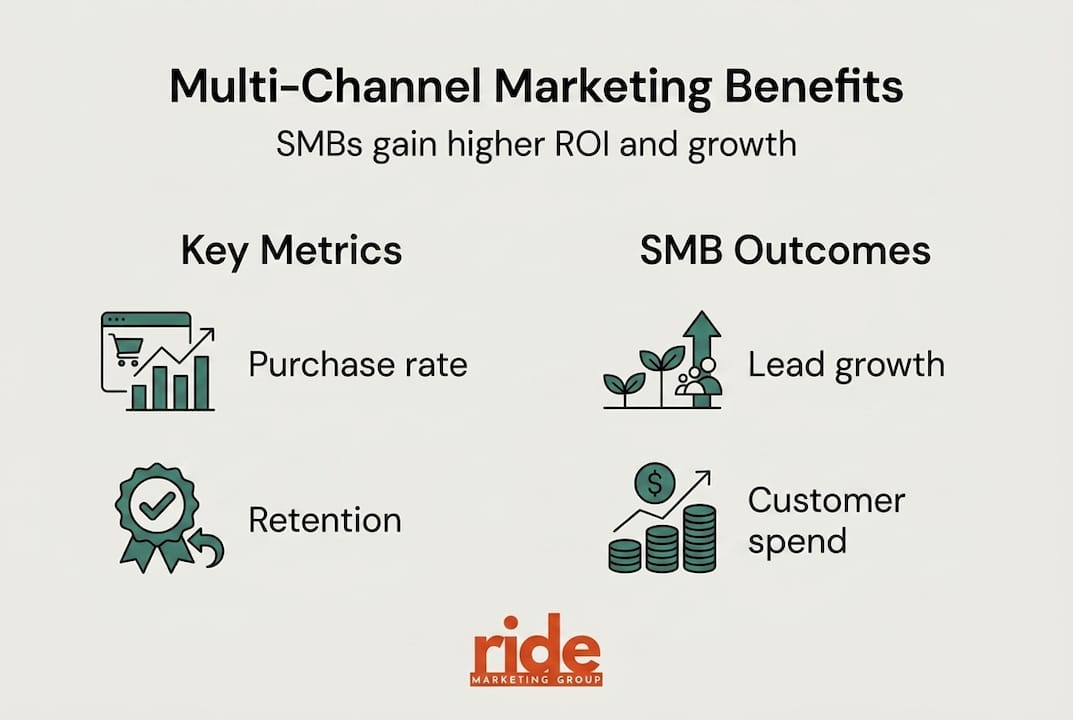
Here is a quick comparison to make the difference concrete:
| Metric | Single-channel | Multi-channel (3+ channels) |
|---|---|---|
| Purchase rate | Baseline | Up to 494% higher |
| Customer retention | Baseline | Up to 90% higher |
| Customer spend | Baseline | 2 to 5x higher |
| Reported ROI ranking | Moderate | Top-ranked tactic (78% of marketers) |
The pattern is clear. More channels, done strategically, produce compounding results. The key word is strategically. Throwing up five channels at once without a plan produces noise, not leads.
Key benefits to keep front of mind:
- Wider audience reach across different platforms and behaviors
- More touchpoints to build trust before a purchase decision
- Reduced dependency on any single channel (less risk)
- Better data for understanding what actually drives conversions
Pro Tip: You do not need to start with five channels. Pick three that align with where your audience actually spends time. Three well-managed channels will outperform six neglected ones every time.
Common challenges and mistakes to avoid
Understanding the upside is key, but knowing what can go wrong helps you build a smarter, more resilient strategy.
Multi-channel marketing is not without friction. Between 39% and 55% of businesses report struggling with data silos, inventory synchronization issues, and inconsistency between channels. These are not minor annoyances. They can quietly drain your budget and confuse your customers.
“Running channels in isolation is like having three salespeople who have never spoken to each other pitching the same prospect with completely different stories.”
Here are the five most common mistakes SMBs make with multi-channel marketing, and how to avoid each one:
- Inconsistent messaging across channels. Your brand voice, offer, and visuals should feel unified whether someone sees you on Facebook, in an email, or on a Google ad. Create a simple brand messaging document and share it with everyone who touches your marketing.
- No attribution tracking. If you cannot tell which channel is driving leads, you cannot optimize your spend. Set up UTM parameters and basic analytics from day one, even if it is just Google Analytics.
- Data silos between platforms. When your email list, CRM, and ad platforms do not talk to each other, you end up with duplicate contacts, missed follow-ups, and wasted budget. Use simple integrations or a basic CRM to connect your data early.
- Scaling too fast. Adding new channels before you have mastered your current ones is a common trap. Nail two or three channels before expanding.
- Ignoring compliance. Email marketing, SMS, and paid ads all have regulatory requirements (CAN-SPAM, TCPA, etc.). Skipping these steps can result in fines and damaged reputation.
Pro Tip: Before you launch a new channel, write down your core message in one sentence. If you cannot summarize it clearly, your audience will not understand it either. Start with alignment, then add channels.
How SMBs can get started: Simple steps for success
Once common missteps are recognized, here is how SMBs can strategically and confidently launch their own multi-channel plan.
The first question most business owners ask is: which channels should I use? The honest answer is that it depends on where your audience already is. A B2B service business will get more traction on LinkedIn and email than on TikTok. A local restaurant will see better results from Instagram and Google Business Profile than from a podcast.
Here is a straightforward framework to get started:
- Identify your audience. Define who you are trying to reach, what problems they have, and where they spend time online and offline.
- Pick your top two or three channels. Choose based on audience fit, your team’s capacity, and startup cost. Do not pick channels just because they are popular.
- Set clear KPIs for each channel. KPIs (key performance indicators) are the specific numbers you will track, such as email open rates, cost per click, or lead form submissions.
- Align your messaging. Write your core offer and value statement once, then adapt the format for each channel. The message stays consistent; the delivery adapts.
- Launch, measure, and adjust. Run each channel for at least 60 to 90 days before drawing conclusions. Look at what is working and double down on it.
As SPX Commerce highlights, channel-specific optimization matters because not all channels perform equally well for every business type. Here is a quick reference to help you choose:
| Channel | Reach | Complexity | Cost | Best use case |
|---|---|---|---|---|
| Email marketing | Medium | Low | Low | Nurturing leads, retention |
| Social media (organic) | Medium | Medium | Low | Brand awareness, engagement |
| Paid search (Google Ads) | High | Medium | Medium to high | High-intent lead capture |
| SEO and content | High | High | Low to medium | Long-term organic growth |
| Print or direct mail | Local | Low | Medium | Local brand awareness |
Start with what you can manage well. Consistency beats volume every time.
Perspective: Why multi-channel is the smart SMB starting point, but not the endgame
Here is an opinion that does not get said enough: most SMBs are sold on multi-channel marketing as if it is the destination. It is not. It is the on-ramp.
Multi-channel gives you speed, reach, and flexibility without requiring a sophisticated tech stack. That is genuinely valuable, especially when you are trying to grow without a large marketing team. But if you run each channel in isolation indefinitely, you will eventually hit a ceiling. You will not know which channel truly drove a sale. You will send the same prospect the same offer five times because your platforms do not talk to each other. And your retention numbers will plateau.
The businesses that grow past that ceiling are the ones who start building data habits early. They track consistently, even imperfectly. They use a CRM, even a basic one. They document what works. When they are ready to move toward true omnichannel integration, the transition is smooth because the foundation is already there.
Exploring modern marketing approaches while you are still in the multi-channel phase gives you a head start on understanding what integration actually looks like. Do not wait until you are overwhelmed to start connecting your channels. Build the habit now.
Take your multi-channel marketing further with expert support
Building a multi-channel strategy from scratch takes time, testing, and the right tools. If you are ready to move faster and avoid the costly trial-and-error phase, working with a team that specializes in this work makes a real difference.
At RIDE Marketing Group, we help SMBs build marketing systems that actually generate leads across multiple channels. Whether you need a high-converting website through our website projects, a clear picture of where your marketing stands with a free marketing analysis, or a targeted solution like our contractor landing pages, we have the tools and experience to help you grow with confidence. Let us help you build something that works.
Frequently asked questions
What is the main difference between multi-channel and omnichannel marketing?
Multi-channel marketing uses multiple independent channels to reach customers, while omnichannel marketing unifies those channels to create a seamless, integrated customer experience across every touchpoint.
How many channels should an SMB use to see strong results?
Research consistently shows that using at least three channels yields the highest purchase rates and ROI, with some studies showing up to 494% better results compared to single-channel campaigns.
What are the most common mistakes made with multi-channel marketing?
The most frequent issues are inconsistent messaging, poor attribution tracking, and data silos between platforms that prevent you from seeing the full picture of what is driving results.
Is multi-channel marketing expensive or difficult for small businesses?
Not if you start focused. Beginning with two or three well-chosen channels keeps costs manageable and allows you to grow your strategy as your budget and team capacity expand.
%402x.svg)