%402x.svg)
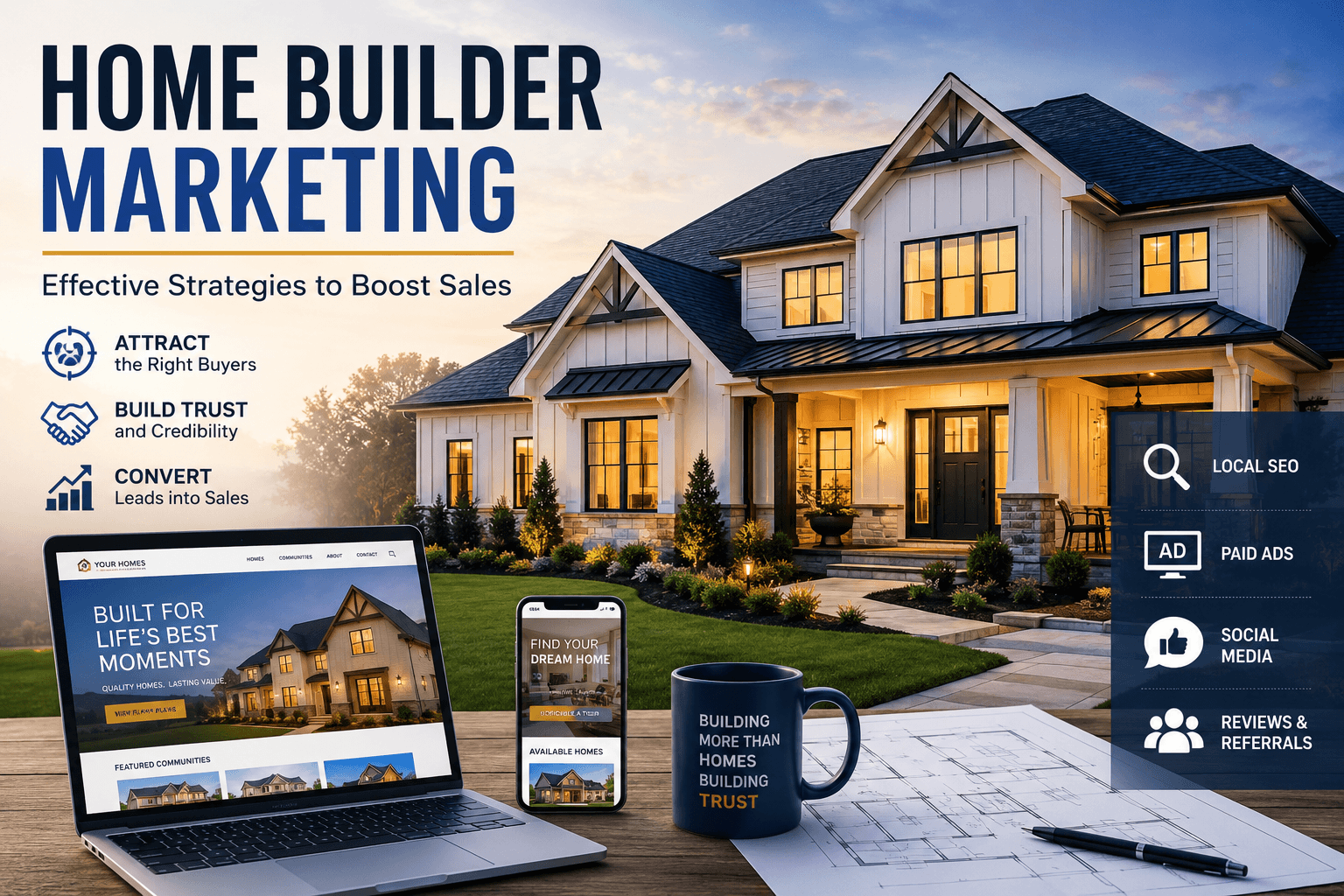
Home Builder Marketing: Effective Strategies to Boost Sales
Marketing your home building business has become harder and more expensive. You're competing for attention in a crowded market where buyers research everything online before they ever contact you. Most builders are spending more on marketing than ever but getting fewer quality leads.
Marketing your home building business has become harder and more expensive. You're competing for attention in a crowded market where buyers research everything online before they ever contact you. Most builders are spending more on marketing than ever but getting fewer quality leads.
The key to successful home builder marketing in 2026 is building an integrated system that guides buyers from their first search to a signed contract. Random tactics don't work anymore. You need a strategy that attracts the right buyers, builds their trust, and converts them efficiently.
Building a Strong Foundation for Home Builder Marketing
Your marketing success depends on tracking the right numbers and knowing where your best buyers come from. Setting up proper metrics and building a clear brand strategy helps you spend your marketing budget wisely and attract qualified leads.
Understanding Key Metrics: Conversion Rates, Cost Per Lead, and Cost Per Sale
Track website-to-inquiry and inquiry-to-sale conversion rates separately. Establish a baseline from your own records and compare results by lead source, project type and time period.
Cost per lead (CPL) tells you how much you spend to get one potential buyer's contact information. Calculate this by dividing your total marketing spend by the number of leads generated. Home builders typically see CPLs ranging from $50 to $300, depending on location and home price point.
Cost per sale shows your actual customer acquisition cost. Divide your total marketing spend by the number of homes sold. This metric matters most because it connects your marketing budget directly to revenue. If you spend $30,000 on marketing and sell 10 homes, your cost per sale is $3,000.
Monitor these numbers monthly to spot trends. When your CPL increases but conversion rates stay flat, your lead quality might be dropping. When conversion rates fall but CPL stays steady, your sales process needs attention.
Identifying Profitable Lead Sources and Maximizing Lead Quality
Different marketing channels produce different quality leads at different costs. Track where each lead comes from using CRM software or simple spreadsheets. Common sources include Google Ads, SEO, social media, referrals, and walk-ins.
High-value lead sources typically include:
- Direct referrals from past clients
- SEO organic search traffic
- Local real estate agent partnerships
- Model home visits
Lower-converting sources often include:
- Broad social media campaigns
- General awareness advertising
- Third-party listing sites
Test each channel for 3-6 months before making decisions. A channel with a $200 CPL that converts at 25% performs better than a $100 CPL source converting at 5%. Focus your budget on channels that deliver qualified leads who match your ideal buyer profile and have realistic budgets.
Crafting a Compelling Brand Presence and Strategy
Your brand tells buyers why they should choose you over other builders. Start by defining what makes your homes different. This might be energy efficiency, custom design options, warranty coverage, or construction quality.
Build consistent messaging across all platforms. Use the same value propositions on your website, social media, email campaigns, and sales materials. Your brand voice should reflect your target buyer's values and preferences.
A strong brand presence requires professional visuals. Invest in quality photography, floor plans, and property tours that showcase your work. Create content that addresses buyer concerns like financing options, construction timelines, and neighborhood amenities.
Your builder marketing strategy should connect your brand to local SEO efforts. Claim and optimize your Google Business Profile with current listings and authentic customer reviews. Use location-specific keywords in your website content to help local buyers find you when searching for new homes in your area.
High-Impact Marketing Channels and Tactics for Builders
Home builders need specific marketing channels that address long sales cycles and high-stakes purchasing decisions. The most effective strategies combine organic visibility through SEO with paid advertising, visual storytelling through social media and photography, and trust-building through reviews and referrals.
Optimizing Online Visibility: Search Engine Optimization and Local SEO
Local search can help prospective customers find builders serving their area. Create useful pages that explain your services, show relevant work and make it easy to request a conversation.
Local SEO focuses on geographic search terms like "custom home builder in [city]" or "build on your lot [neighborhood]." You need separate landing pages for each service area and community you serve. These pages should include specific details about building in that neighborhood, local zoning information, and completed projects in the area.
Keep your Google Business Profile accurate, with current contact details, services, hours and relevant photos. Ask customers for honest feedback and respond helpfully to reviews.
Key local SEO elements:
- One landing page per neighborhood you serve
- Schema markup on all property listings
- Mobile-friendly website with under 3-second load time
- Active Google Business Profile with fresh content
- Local backlinks from chambers of commerce and community organizations
Leveraging Paid Strategies: Google Ads, Facebook Ads, and Paid Social
Paid search through Google Ads captures buyers who are actively looking for builders right now. You should bid on high-intent keywords like "[city] custom home builder" and "build on your lot [city]." Local Service Ads appear above regular search results and charge per lead instead of per click.
Facebook Ads and paid social work differently than Google Ads. Most buyers aren't scrolling Facebook looking for a builder. Instead, use Meta ads to retarget people who visited your website but didn't fill out a form. Carousel ads featuring model home photos and drone videos of completed communities perform well for remarketing.
Your paid search campaigns need dedicated landing pages for each ad group. Sending traffic to your homepage cuts conversion rates by half. Each landing page should match the specific search term and feature a simple 3-5 field form.
Set a marketing budget around your capacity, margins and growth goals. Start with channels you can measure, compare qualified inquiries and booked work, and adjust spending using your own results.
Driving Engagement Through Social Media, Photo Galleries, and Drone Footage
Buyers can't picture an unbuilt home from text descriptions alone. Visual content shows them what their finished home will look like and builds confidence in your craftsmanship.
Professional photo galleries of completed homes should be organized by style, square footage, and price range. Include exterior shots, interior rooms, design details, and outdoor living spaces. Each gallery needs detailed specifications and the option to save favorites or request similar floor plans.
Drone footage gives buyers a complete view of your communities and lots. Aerial videos show property boundaries, nearby amenities, and neighborhood context better than ground-level photos. Time-lapse videos of construction progress demonstrate your building process and attention to detail.
High-performing visual content types:
- 3D virtual walkthroughs of model homes
- Drone reels of completed communities (60-90 seconds)
- Before-and-after renovation videos
- Construction progress time-lapses
- Instagram Reels and TikTok videos of design details
Social media marketing for home builders works best on Instagram and Facebook. Post completed projects, share design trends, announce new communities, and showcase customer testimonials. Video content gets 3-5 times more engagement than static images.
Harnessing Trust: Referrals, Testimonials, and Google Business Profile
Trust determines which builder a buyer chooses. Your marketing needs to prove you'll deliver quality work on time and on budget.
Ask customers for honest reviews after an appropriate project milestone. Respond thoughtfully to feedback, including concerns, and use recurring comments to improve the customer experience.
Written and video testimonials from past clients carry more weight than any claim you make about yourself. Feature testimonials prominently on your homepage and service pages. Include the customer's name, photo, community, and specific details about their experience.
Referrals from past clients cost nothing and close at higher rates than cold leads. Build a formal referral program that rewards both the referrer and the new buyer. A $1,000 credit to the past client and $500 credit to the new buyer creates clear incentive to refer.
Real estate agent partnerships generate consistent qualified leads. Realtors with land buyers need builders for their clients. Host quarterly events for local agents, provide co-branded marketing materials, and maintain a dedicated agent portal on your website with commission structures and available lots.
Frequently Asked Questions
Builder marketing generates the most questions around lead quality, channel mix, and proving ROI in a high-ticket, long-cycle sale. The answers come down to local relevance, buyer-stage alignment, and transparent tracking.
What are the most effective ways to generate qualified new-home buyer leads in a local market?
Local search can help prospective customers find builders serving their area. Create useful pages that explain your services, show relevant work and make it easy to request a conversation.
Your Google Business Profile should be updated weekly with photos, posts, and Q&A responses. Aim for at least eight new reviews per month to stay competitive in the Map Pack.
High-intent Google Search Ads targeting phrases like "build on your lot [city]" and "custom home builder [neighborhood]" capture buyers actively comparing builders. Local Service Ads add pay-per-lead options for the same searches.
Hyper-local landing pages focused on one neighborhood or community perform better than generic service pages. A page titled "Custom Homes in [Specific Neighborhood]" converts at three to eight times the rate of a citywide service page.
Referral partnerships with realtors and lenders bring warm leads who already trust the source. Set up co-marketing agreements and reciprocal referral incentives.
How should a construction company structure its marketing strategy across website, SEO, and paid ads?
Your website is the conversion hub. Everything else drives traffic to it. Your site needs live inventory, mobile-first design, under three-second load time, and simple lead forms with three to five fields maximum.
SEO builds long-term organic traffic for high-intent searches. Target location-specific keywords like "[city] custom home builder" and "new construction homes in [neighborhood]." Plan four to eight months to see meaningful organic growth.
Google Ads and Local Service Ads deliver immediate visibility while your SEO builds momentum. Budget 60 to 90 days to optimize campaigns and see consistent lead flow from paid search.
Meta and Instagram remarketing keeps your brand in front of website visitors who didn't convert. Use carousel ads featuring model home photos and drone reels of communities you're building in.
Your email and SMS nurture sequences turn one-time visitors into qualified leads over six to 18 months. Most custom home buyers take that long to decide, so you need automated touchpoints that stay relevant without being pushy.
Which website pages and content assets are most likely to convert prospects into consultations?
Model home pages with 3D virtual tours and interactive floor plans drive the highest conversion rates. Buyers want to visualize the home before they schedule a visit.
Community-specific landing pages that show available homesites, pricing ranges, and neighborhood amenities convert better than generic service pages. Add map embeds and drone footage of the area.
Lead magnets like build-on-your-lot checklists, cost guides, and financing comparison PDFs capture email addresses from buyers who aren't ready to talk yet. Offer them in exchange for a download.
Testimonial and case study pages build trust at the decision stage. Include real buyer names, photos of completed homes, and specific details about the build process.
Interactive pricing tools that let buyers see real costs as they change options increase transparency and reduce sticker shock later. Buyers appreciate knowing what they'll pay before the first consultation.
Live inventory feeds showing move-in-ready homes and available lots create urgency. Update your site daily or weekly so buyers see current availability, not six-month-old listings.
How can a builder improve Google Business Profile visibility and earn more high-quality reviews?
Post weekly updates to your Google Business Profile. Share new model home photos, community progress updates, and buyer success stories. Posts boost engagement and signal to Google that your profile is active.
Upload high-quality photos at least monthly. Include exterior and interior shots, drone footage, and finished home galleries. Profiles with frequent photo updates rank higher in local search.
Answer every question in the Q&A section. Monitor it weekly and respond with clear, helpful answers. Unanswered questions hurt your ranking and make you look unresponsive.
Request reviews from every buyer at move-in and at the one-year mark. Use a simple email or SMS with a direct link to your Google review page. Follow up once if they don't respond within a week.
Respond to every review within 48 hours. Thank positive reviewers by name and address negative reviews calmly with a brief factual response. Consistent engagement shows you care about buyer experience.
Verify your profile is completely filled out. Add all service areas, business hours, website link, phone number, and builder-specific attributes like "custom homes" and "build on your lot."
What budget and performance benchmarks should be used to evaluate paid search and social campaigns?
Custom and small-volume builders should budget three to seven percent of revenue for marketing. Production builders typically spend one to three percent because they have economies of scale.
Cost per lead benchmarks vary by market, but expect $100 to $400 per lead for Google Search Ads in competitive metros. Local Service Ads usually cost $50 to $150 per lead.
Cost per click on Google Search Ads for builder-related keywords typically runs $5 to $20 in suburban markets and $15 to $50 in major metros. Track your cost per click monthly to spot unusual spikes.
Conversion rate from website visitor to lead should be at least two to four percent. If you're below two percent, your website or landing pages need work.
Lead-to-appointment rate should be 15 to 30 percent for qualified leads. Lower rates mean your nurture process or sales follow-up needs improvement.
Plan 60 to 90 days to optimize paid campaigns and see consistent results. The first 30 days are testing and learning. Real performance data shows up in months two and three.
How can a builder differentiate its brand and messaging in a competitive new-construction market?
Niche down by build type or buyer profile. Instead of "custom home builder," position as "luxury custom homes for growing families" or "build on your lot specialist in [region]."
Showcase your process with transparency. Create content that walks buyers through every phase of the build, from site selection to final walkthrough. Most builders hide their process, so showing yours builds trust.
Use real project stories instead of generic marketing copy. Feature specific builds with buyer testimonials, challenge-solution narratives, and before-and-after visuals.
Invest in high-quality visual content that competitors skip. Drone footage, time-lapse build videos, 3D virtual tours, and interactive floor plans set you apart from builders still using static photos.
%402x.svg)